How competitor SEO analysis works
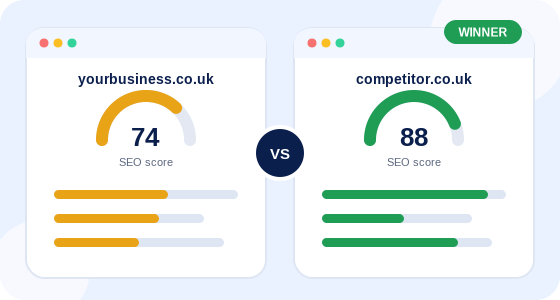
Two websites, the same 100+ checks, one clear answer to the question: why are they ahead of me?
Add your page
Enter the page you want to rank, such as your home page or a key service page.
Add a rival
Search Google for your main keyword and copy the address of a page that ranks above you.
Compare side by side
Both pages are tested at the same time and every result lines up in one table.
Close the gaps
Look for rows where they win. Those are your quickest routes to better rankings.
What the comparison shows you
Every result lines up side by side, so you can see in seconds where a rival is stronger.
Scores and winners
Overall SEO score and section scores for both sites, with the stronger result clearly marked.
Content depth
Word count, headings and keyword use, so you can see if their page simply says more.
Speed
Server response time and Core Web Vitals, to show whose page loads faster on mobile.
Structured data
Which schema types each page uses, such as reviews, FAQs or local business details.
Links
Internal and external links on each page, and how well they guide visitors and search engines.
Trust and security
HTTPS, security headers and the signals that help both people and Google trust a page.
Why do a competitor SEO analysis?
Your own SEO score tells you how your page is doing. A competitor SEO analysis tells you why someone else is beating it in Google, and what to change first.
- Same 100+ checks
- Tested at the same moment
- Results side by side
When a rival appears above you in Google, it is easy to guess why: maybe they have been around longer, or they spend more on advertising. In reality, the reason is often something simple on the page itself, such as a clearer title, more helpful content or a page that loads two seconds faster on a phone.
A side-by-side competitor website audit takes the guesswork out. Because both pages are tested with exactly the same checks at the same moment, every difference you see is real and measurable. That makes it much easier to decide where to spend your time, or what to ask your web designer to change.
It also works the other way round. If your page already beats a competitor on most rows, you know the gap is more likely to be about links, reviews or brand awareness, and you can focus your effort there instead.
Once you have made your changes, run the same comparison again. Watching the gap close row by row shows whether your work is paying off, and repeating the check every few months helps you spot when a competitor improves their page before it costs you rankings.
What to compare firstFive places where rivals usually pull ahead
- Page title and descriptionDo they use the search phrase more clearly than you, and does their listing make a stronger promise?
- Content depthDo they answer more of the questions your customers ask, such as prices, areas covered or delivery times?
- Speed on mobileA faster page keeps more visitors, especially on slower 4G connections.
- Structured dataReviews, FAQs and business details can earn richer results in Google.
- Internal linksPages that are well linked from the rest of the site tend to be seen as more important.
Tips for a fair comparison
A few simple habits make your comparison far more useful.
- Compare like with like. Put your service page against their service page, not against their home page.
- Pick a real rival. Choose a site that ranks for the keyword you want, ideally a UK business of a similar size.
- Do not copy, improve. If their page is longer, answer more of your customers' questions rather than padding out your text.
- Check again later. Run the comparison again a few weeks after your changes to see how far you have closed the gap.
Competitor comparison questions
Is the competitor comparison free?
Yes. Like our main SEO checker, it is completely free with no sign-up.
Will the other website know I compared it?
No. The tool loads their public page once, like any normal visitor, so nothing tells them who ran the check.
Can I compare more than two websites?
Each comparison covers two pages. To check a third site, simply run another comparison with your page and the new rival.
Why does a competitor with a lower score rank above me?
An on-page score is only part of the picture. Backlinks, brand searches and how long a site has been around also matter. The comparison helps you fix everything that is in your control on the page itself.
Which pages should I compare?
Search Google for the keyword you care about most, then compare your page with one of the top three results for that search.